Industrial Equipment Supplier Website Design: Complete Guide to Build a Professional B2B Industrial Website
In today’s competitive industrial market, having a professional website is essential for industrial equipment suppliers, manufacturers, distributors, wholesalers, and machinery dealers. Businesses searching for industrial products now begin their research online before contacting suppliers. A professionally designed industrial equipment supplier website helps generate B2B leads, improve credibility, showcase products, and increase inquiries from potential buyers.
Whether you supply construction equipment, factory machinery, heavy industrial tools, electrical systems, hydraulic equipment, manufacturing machines, safety products, engineering tools, or industrial automation solutions, your website acts as a digital showroom and sales platform.
This comprehensive guide explains everything about industrial equipment supplier website design, including essential features, SEO strategies, product catalog optimization, lead generation techniques, mobile responsiveness, and best practices for building a high-converting industrial website.
Why Industrial Equipment Suppliers Need a Professional Website
Modern buyers research suppliers online before making purchasing decisions. Without a professional website, industrial businesses lose credibility and potential contracts.
A high-quality industrial supplier website helps:
- Generate B2B inquiries
- Build trust and authority
- Showcase industrial products
- Improve Google rankings
- Expand market reach
- Display technical specifications
- Increase distributor inquiries
- Support digital marketing campaigns
- Strengthen brand image
- Improve customer communication
Your website becomes a 24/7 sales and marketing platform for your industrial business.
Benefits of Industrial Equipment Supplier Website Design
1. Professional Product Showcase
An industrial website allows businesses to present machinery and equipment professionally.
You can display:
- Product categories
- Technical specifications
- Product images
- Videos
- Certifications
- Brochures
- Case studies
Professional presentation improves buyer confidence.
2. Better B2B Lead Generation
Industrial buyers often compare suppliers online before contacting them.
A strong website can generate inquiries through:
- Google search traffic
- SEO optimization
- LinkedIn marketing
- Paid advertising
- Product searches
Lead generation improves long-term business growth.
3. Improved Brand Credibility
Industrial buyers prefer suppliers with professional online presence.
A modern website creates trust and professionalism.
4. Better Global Reach
A website allows industrial suppliers to expand beyond local markets and attract national or international buyers.
Essential Features of Industrial Equipment Supplier Website Design
A successful industrial website should combine professional design, fast performance, SEO optimization, and easy product navigation.
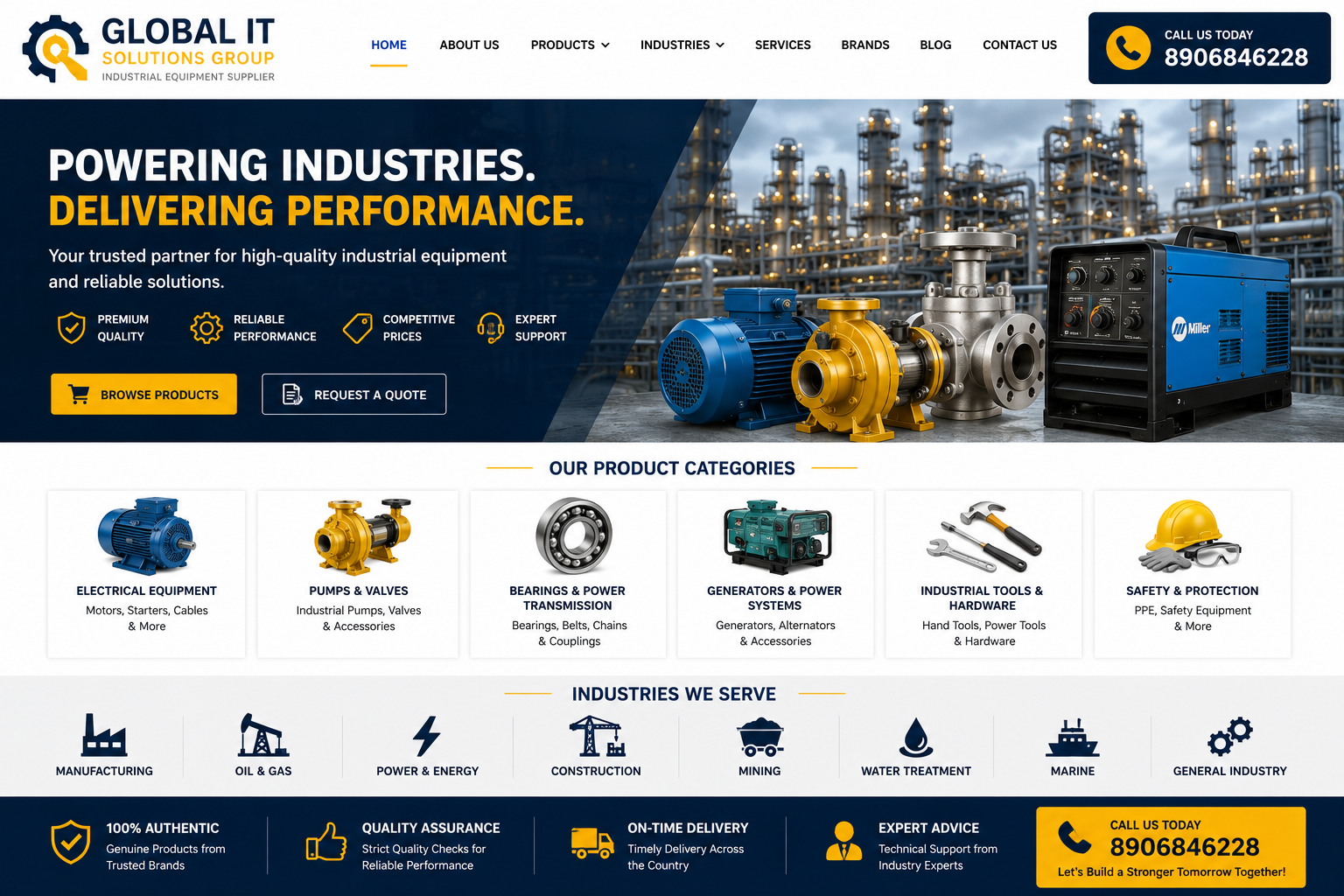
Professional Homepage Design
The homepage should immediately explain:
- What products you supply
- Industries you serve
- Why businesses should choose you
- How buyers can contact you
Important homepage sections include:
- Hero banner
- Product categories
- Company overview
- Certifications
- Industries served
- Client logos
- CTA buttons
- Inquiry forms
- Testimonials
- Contact information
Example headline:
“Reliable Industrial Equipment Solutions for Manufacturing, Construction & Engineering Industries”
Product Catalog and Equipment Listings
Product catalogs are one of the most important sections of industrial websites.
Each product page should include:
- Product name
- Technical specifications
- Product images
- Datasheets
- Application details
- Videos
- Inquiry buttons
- Downloadable brochures
Well-organized catalogs improve user experience and conversions.
Mobile-Friendly Industrial Website Design
Industrial buyers increasingly browse websites on mobile devices.
A responsive website ensures:
- Better user experience
- Faster browsing
- Improved SEO rankings
- Easy inquiry submission
- Better engagement
Your website should work smoothly across:
- Smartphones
- Tablets
- Laptops
- Desktop devices
Mobile responsiveness is now essential for B2B websites.
Fast Website Loading Speed
Website speed impacts both SEO and user experience.
Slow industrial websites can reduce inquiries and increase bounce rates.
Ways to improve speed include:
- Optimized product images
- Fast hosting
- Lightweight coding
- Browser caching
- CDN integration
Fast websites improve professionalism and engagement.
SEO Optimization for Industrial Equipment Supplier Websites
SEO helps industrial businesses attract organic traffic from Google.
A properly optimized industrial website can generate long-term B2B leads.
Important Industrial SEO Keywords
Examples include:
- Industrial equipment supplier website design
- Industrial machinery supplier
- Heavy equipment supplier
- Manufacturing equipment company
- Industrial automation supplier
- Hydraulic equipment supplier
- Construction machinery dealer
- Engineering equipment supplier
Use keywords naturally in:
- Titles
- URLs
- Headings
- Meta descriptions
- Product pages
- Blog content
- Image alt tags
Local SEO for Industrial Businesses
Industrial suppliers targeting regional clients should optimize for local SEO.
Examples:
- Industrial equipment supplier in Kolkata
- Machinery supplier in Mumbai
- Hydraulic equipment supplier in Delhi
- Industrial tools dealer in Bangalore
Local SEO strategies include:
- Google Business Profile
- Location-specific keywords
- Customer reviews
- Local citations
- Google Maps integration
Local SEO improves nearby business visibility.
Industries Served Section
Industrial websites should clearly display industries served.
Examples include:
- Manufacturing
- Construction
- Oil and gas
- Automotive
- Pharmaceuticals
- Agriculture
- Power generation
- Mining
- Warehousing
- Engineering
Industry-specific sections improve buyer trust.
Importance of Technical Content
Industrial buyers often require detailed technical information.
Useful content includes:
- Product specifications
- User manuals
- Installation guides
- Safety instructions
- Technical brochures
- Maintenance guides
Detailed information improves decision-making.
Online Inquiry and Quote Request Forms
Industrial websites should make inquiries simple.
Important features include:
- Quote request forms
- Product inquiry forms
- WhatsApp integration
- Email contact buttons
- Consultation booking
- Live chat support
Easy communication improves lead conversion.
Trust Signals and Certifications
Industrial buyers prefer verified and certified suppliers.
Display:
- ISO certifications
- Industry memberships
- Client logos
- Awards
- Case studies
- Testimonials
- Safety certifications
Trust signals increase buyer confidence.
Best Color Schemes for Industrial Websites
Popular industrial website colors include:
- Blue for professionalism
- Gray for industrial appearance
- Black for strength
- Orange for energy
- Green for engineering and sustainability
Consistent branding improves recognition.
User-Friendly Website Navigation
Simple navigation improves usability.
Recommended menu structure:
- Home
- About Us
- Products
- Industries
- Services
- Certifications
- Blog
- Contact Us
Easy navigation helps buyers find products quickly.
Product Search and Filtering System
Industrial websites often contain large product catalogs.
Advanced search filters help users browse products by:
- Category
- Brand
- Application
- Industry
- Product type
- Specifications
Efficient filtering improves user experience.
Industrial Blog Content for SEO
Blogging helps industrial businesses improve search rankings.
Useful blog topics include:
- Industrial automation trends
- Equipment maintenance tips
- Safety best practices
- Manufacturing technology
- Hydraulic system guides
- Construction machinery insights
Blogs establish authority and increase organic traffic.
Call-to-Action Buttons
Strong CTAs improve lead generation.
Examples include:
- Request Quote
- Download Brochure
- Contact Supplier
- Get Consultation
- View Products
CTAs should be visible throughout the website.
Social Media Integration
Industrial businesses increasingly use digital platforms.
Useful social media channels include:
- YouTube
Social integration improves visibility and B2B networking.
Industrial Website Design Trends
Modern industrial websites use trends such as:
- Minimal layouts
- Video backgrounds
- Interactive product catalogs
- 3D product visualization
- Dark mode
- Mobile-first design
- AI chatbots
- Smart inquiry systems
Modern design improves engagement and professionalism.
Security Features for Industrial Websites
Your website should include:
- SSL certificates
- Secure hosting
- Firewall protection
- Spam protection
- Backup systems
Security improves trust and protects business data.
Why Custom Industrial Website Design is Better
Custom-designed industrial websites provide:
- Unique branding
- Better scalability
- Improved SEO
- Faster performance
- Advanced functionality
- Better product presentation
Custom websites help industrial suppliers stand out professionally.
Conversion Optimization Tips
To increase inquiries and conversions:
- Use strong headlines
- Display certifications
- Simplify inquiry forms
- Improve loading speed
- Add trust indicators
- Use clear CTAs
- Optimize for mobile
Optimization improves website ROI.
Common Industrial Website Mistakes
Avoid these common problems:
Poor Product Presentation
Low-quality catalogs reduce trust.
Slow Website Speed
Slow websites frustrate users.
Weak SEO
Without SEO, buyers may not find your business online.
Poor Mobile Experience
Mobile users expect smooth browsing.
Complicated Navigation
Complex menus reduce usability.
Missing Technical Information
Industrial buyers need detailed specifications.
Best Pages for Industrial Equipment Supplier Websites
Important pages include:
- Home
- About Us
- Products
- Industries Served
- Certifications
- Blog
- Testimonials
- FAQ
- Contact Us
- Privacy Policy
Well-structured pages improve SEO and user experience.
Why WordPress is Popular for Industrial Websites
WordPress is widely preferred because it offers:
- Easy content management
- SEO plugins
- Product catalog functionality
- Mobile responsiveness
- Scalability
- Customization flexibility
WordPress is ideal for industrial businesses wanting long-term scalability.
AI and Automation for Industrial Websites
Modern industrial websites increasingly use:
- AI chatbots
- Smart product recommendations
- Automated inquiries
- CRM integrations
- Personalized content systems
Automation improves customer management and efficiency.
Analytics and Performance Tracking
Analytics tools help industrial businesses monitor performance.
Track:
- Website traffic
- Inquiry rates
- Product page visits
- User behavior
- Conversion sources
Google Analytics and Search Console are highly valuable.
Choosing the Right Industrial Website Design Company
Before hiring a web design company, check:
- Industrial industry experience
- SEO expertise
- Product catalog experience
- Mobile optimization
- Technical support
- Branding capabilities
A professional development partner helps build a strong industrial brand online.
Future of Industrial Equipment Supplier Websites
Industrial websites continue evolving with technology.
Future trends include:
- AI-powered product search
- Voice search optimization
- Augmented reality product viewing
- Smart catalogs
- Personalized B2B experiences
- Automation tools
Industrial businesses adopting digital innovation will remain competitive.
Conclusion
A professional industrial equipment supplier website is essential for generating B2B leads, showcasing products, building credibility, and expanding market reach. A successful industrial website combines modern design, SEO optimization, fast performance, mobile responsiveness, and user-friendly navigation.
Whether you supply industrial machinery, engineering tools, construction equipment, hydraulic systems, or automation products, your website should reflect professionalism, technical expertise, and trustworthiness.
Investing in high-quality industrial equipment supplier website design can significantly improve your visibility, inquiries, and long-term business growth in the competitive industrial marketplace.
FAQs – Industrial Equipment Supplier Website Design
1. Why does an industrial equipment supplier need a website?
A website helps generate B2B leads, showcase products, improve credibility, and expand market reach.
2. What should an industrial website include?
Important sections include product catalogs, technical specifications, inquiry forms, certifications, and contact pages.
3. Is SEO important for industrial websites?
Yes. SEO helps industrial businesses rank on Google and attract targeted buyers.
4. Should industrial websites be mobile-friendly?
Absolutely. Many buyers browse websites on smartphones and tablets.
5. What platform is best for industrial websites?
WordPress is highly popular because it offers flexibility, SEO tools, and scalability.
6. Why are product catalogs important?
Detailed product catalogs help buyers understand specifications and make informed decisions.
7. How can industrial websites generate leads?
Through SEO, Google Ads, LinkedIn marketing, inquiry forms, and content marketing.
8. Why are certifications important on industrial websites?
Certifications build trust and demonstrate quality standards.
9. What colors work best for industrial websites?
Blue, gray, black, orange, and green are commonly used for industrial branding.
10. Is custom website design better than templates?
Yes. Custom websites provide stronger branding, better SEO, advanced functionality, and improved scalability.
Call : +91 8906846228
Our Services
Website Design & Development
Mobile App Development
Digital Marketing
Search Engine Optimization (SEO)
Software Development
IT Solutions
Recent Post