
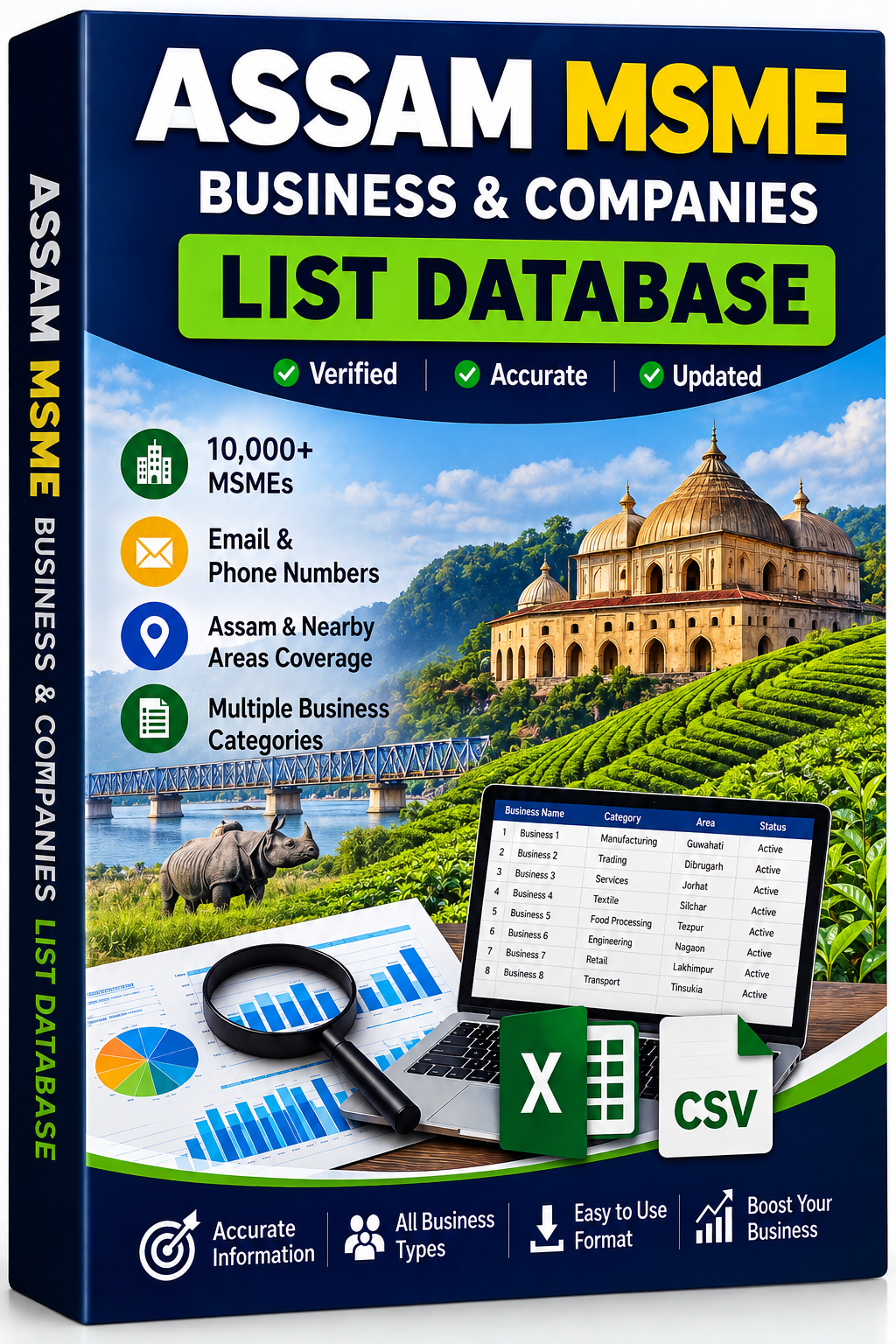
Assam MSME Business and Companies List Database
₹ 1,000.00
Assam MSME Business and Companies List Database: A Resource for Business Research and Market Analysis
Assam has emerged as an important business destination in Northeast India, supported by its strategic location, natural resources, growing infrastructure, and expanding consumer market. Micro, Small and Medium Enterprises (MSMEs) play an important role in the state economy by supporting manufacturing, services, trade, employment, entrepreneurship, and local supply chains.
An Assam MSME Business and Companies List Database can be a useful research resource for entrepreneurs, businesses, market researchers, suppliers, investors, consultants, and organizations interested in understanding the state’s business ecosystem. A professionally organized database can help users study businesses by industry, business category, district, enterprise type, and other relevant business characteristics.
This type of database is intended for business research and market analysis and does not need to include personal contact details. Instead, the focus can remain on business-oriented information such as company or enterprise name, industry, business category, location, district, and MSME classification where legally and appropriately available.
Growing Importance of MSMEs in Assam
MSMEs are an important part of India’s entrepreneurial ecosystem, and Assam has a substantial number of registered enterprises. The Ministry of MSME’s state-wise dashboard currently shows more than 1.2 million Udyam registrations in Assam, with micro enterprises representing the overwhelming majority. When Udyam Assist Platform registrations are included, the dashboard reports more than 1.8 million MSMEs and related registrations in the state.
These figures demonstrate the broad diversity of small businesses operating across Assam. Businesses range from traditional manufacturing and handicrafts to food processing, retail, professional services, transportation, technology, hospitality, construction, and other commercial activities.
The Government of Assam has also identified several areas as important thrust sectors. These include automobile, bamboo, cold chain and cold storage, engineering, food processing, jute, pharmaceuticals, plastics, rubber, sugar, and textiles. Service-sector areas include hotels and resorts, river cruises, infrastructure development, and green-energy-related activities.
What Is an Assam MSME Business Database?
An Assam MSME business database is an organized collection of information about eligible or identified businesses operating across different parts of the state.
Rather than functioning as a simple company directory, a well-structured database can categorize enterprises according to useful business attributes. Depending on the purpose and source, fields may include:
- Business or enterprise name
- Business category
- Industry or sector
- Manufacturing or service classification
- MSME category
- District
- City or town
- Business activity
- Product category
- Year of establishment, where publicly available
- Registration-related information where legally available
- Business size classification
- Source or verification date
The database can intentionally exclude personal phone numbers, private email addresses, residential addresses, and other sensitive personal information. This makes it more appropriate for research, analysis, business intelligence, and responsible business discovery.
Major MSME Business Categories in Assam
Assam’s business environment includes enterprises from numerous industries. A comprehensive database can therefore cover a broad range of categories.
1. Food Processing Businesses
Food processing is an important opportunity in Assam because the state has agricultural and horticultural resources. MSMEs can operate in areas such as packaged food, spices, rice processing, fruit processing, beverages, bakery products, traditional food products, and agricultural value-added products.
A business database can help researchers identify enterprises involved in different segments of food processing and compare activity across districts.
2. Tea-Related Businesses
Assam is internationally recognized for its tea industry. Alongside large tea estates, the wider tea ecosystem includes smaller businesses involved in processing, packaging, distribution, specialty products, equipment, logistics, and retail.
Including tea-related enterprises in an MSME database can provide useful insights into one of Assam’s most recognizable commercial sectors.
3. Bamboo and Cane Businesses
Bamboo and cane have significant cultural and economic importance in Northeast India. Assam has businesses involved in bamboo products, furniture, handicrafts, construction-related products, decorative items, packaging, and other value-added activities.
The state government has also maintained a dedicated Bamboo and Cane Policy, reflecting the importance of this sector.
4. Handicrafts and Handloom
Handloom and handicrafts provide opportunities for artisans, entrepreneurs, cooperatives, manufacturers, designers, retailers, and exporters.
A structured business database can categorize enterprises according to textile products, handloom products, handicrafts, traditional clothing, home décor, and other related activities.
5. Manufacturing Enterprises
Manufacturing MSMEs form another important category. Businesses may be involved in engineering products, machinery components, packaging materials, furniture, building products, garments, plastics, electrical products, and other manufactured goods.
The database can classify these businesses according to their principal activity, making it easier for researchers to understand the manufacturing landscape.
6. Construction and Infrastructure Services
Infrastructure development creates opportunities for contractors, material suppliers, equipment providers, engineering firms, architects, project-support businesses, and other service providers.
A business database can help identify companies operating in construction-related industries without exposing private contact information.
7. Information Technology and Digital Services
Assam’s growing digital economy has created opportunities for software companies, IT service providers, digital marketing agencies, web service businesses, technology consultants, and other digital enterprises.
These businesses can be classified separately in an MSME database to support technology-sector research and market analysis.
8. Hospitality and Tourism
Assam has significant tourism potential, including wildlife destinations, cultural attractions, river-based tourism, tea regions, and heritage locations.
MSMEs in hotels, restaurants, travel services, tour operations, transportation, event services, and tourism support can be included in an appropriately sourced database.
District-Wise Business Research
One of the major advantages of an Assam MSME database is the ability to organize businesses geographically.
Assam consists of multiple districts with different economic characteristics. A district-wise database can help users examine business activity in locations such as Guwahati and other urban, semi-urban, and rural areas.
Geographical categorization may include:
- District
- City
- Town
- Industrial area
- Business category
- Industry
- Enterprise classification
This organization can make the database more useful for market research and regional business studies.
Why Businesses Use MSME Databases
A well-organized business database can serve several legitimate purposes.
Market Research
Businesses can use industry and location-based information to understand the size and diversity of a potential market.
Supplier Research
Manufacturers and distributors may use business information to identify potential suppliers or commercial partners.
B2B Market Analysis
Companies entering Assam can study existing business categories and identify areas where demand, competition, or collaboration opportunities may exist.
Investment Research
Investors and consultants can use aggregated business information to understand local industry concentration and emerging sectors.
Academic and Economic Research
Students, researchers, institutions, and analysts can use business data to study entrepreneurship, regional development, employment patterns, and industrial diversification.
Business Planning
Entrepreneurs can examine existing business categories before launching a new product or service. This can help them understand competition and identify underserved market segments.
Importance of Accurate and Responsible Data
The quality of a business database depends heavily on the reliability and freshness of its information. Business registrations, classifications, addresses, activities, and operating status can change over time.
Therefore, users should treat a database as a research resource rather than assuming that every record represents a currently active business. Important information should be verified through appropriate official or publicly available sources before making financial, legal, contractual, or investment decisions.
The official Udyam Registration portal states that MSME registration is free and paperless and provides the current MSME classification framework. From April 1, 2025, the classification limits were revised, with micro enterprises having investment up to ₹2.5 crore and turnover up to ₹10 crore, small enterprises up to ₹25 crore investment and ₹100 crore turnover, and medium enterprises up to ₹125 crore investment and ₹500 crore turnover.
Because classifications and government data can change, database publishers should clearly mention the source and update date wherever appropriate.
No Contact Details: A More Focused Database
An Assam MSME database does not have to contain phone numbers, personal email addresses, WhatsApp numbers, or other direct contact information.
For many research purposes, business-level information is sufficient. A database without contact details can focus on:
Business Name + Industry + Category + District + Location + Enterprise Type + Business Activity
This approach can make the resource more suitable for market research, statistical analysis, competitive research, content creation, and business planning.
It also reduces unnecessary exposure of personal information and encourages users to verify business information through legitimate public or official sources.
Assam’s Business Policy Environment
The Government of Assam has introduced and maintained several policies connected with industrial development and entrepreneurship. Its current policy listings include the Industrial and Investment Policy, startup and innovation initiatives, logistics and warehousing policies, electronics-related policy, handicraft policy, and policies related to sectors such as ethanol, electric vehicles, aerospace and defence manufacturing, and maintenance, repair and overhaul.
The presence of these policies indicates that Assam’s business ecosystem extends beyond traditional industries. New opportunities are developing across manufacturing, logistics, technology, tourism, renewable energy, specialized services, and emerging industries.
For businesses conducting research, a categorized MSME database can therefore provide a useful starting point for understanding the state’s evolving commercial environment.
How Entrepreneurs Can Use the Database
Entrepreneurs can use an Assam MSME company list to study competitors operating in their chosen industry. For example, someone planning to start a food-processing business may research businesses in food manufacturing, packaging, distribution, and related services.
Similarly, an IT entrepreneur can examine technology and digital-service businesses, while a manufacturer can research suppliers and companies operating in related industrial categories.
The database should be viewed as a starting point for research rather than a substitute for professional due diligence.
Benefits for Market Researchers
Market researchers often need structured information instead of unorganized company names. A categorized Assam MSME database can make research more efficient by allowing businesses to be grouped by:
- Industry
- Product category
- District
- City
- Enterprise type
- Manufacturing or service activity
- Business size
- Market segment
Such categorization can help researchers identify trends, compare regions, and prepare market reports.
Future Opportunities for Assam MSMEs
Assam’s geographic position provides opportunities for businesses serving both the state and the wider Northeast Indian market. Improved infrastructure, logistics, digital connectivity, entrepreneurship programs, and sector-specific policies can create opportunities for new enterprises.
Food processing, logistics, tourism, bamboo products, textiles, technology services, manufacturing, renewable energy, and specialized services are among the areas that can receive continued attention.
The Assam government has also published newer policy initiatives, including the Assam Start-up and Innovation Policy 2025, Aerospace and Defence Manufacturing Policy 2025, MRO Policy 2025, and Logistics and Warehousing Policy 2025.
Conclusion
The Assam MSME Business and Companies List Database can be a valuable resource for understanding the state’s diverse entrepreneurial and industrial ecosystem. From tea and food processing to bamboo, handloom, manufacturing, technology, construction, tourism, logistics, and professional services, Assam has businesses operating across a wide range of sectors.
A useful database should prioritize accurate, structured, business-focused information while avoiding unnecessary personal contact details. Information such as business name, industry, category, district, location, and enterprise classification can provide substantial value for market research, supplier research, competitive analysis, investment studies, and business planning.
As Assam’s business environment continues to evolve, regularly updated and responsibly sourced business information can help entrepreneurs and researchers make better-informed decisions. Users should always verify important business information through official or reliable sources before entering into financial, commercial, or contractual arrangements.
Ultimately, an Assam MSME business database is most valuable when it is treated as a research and discovery resource—one that helps users understand where businesses operate, what industries they represent, and how Assam’s MSME ecosystem is developing, without unnecessarily publishing private contact information.
Related products
Ahmedabad MSME Business and Companies List Database
Reviews
There are no reviews yet.