
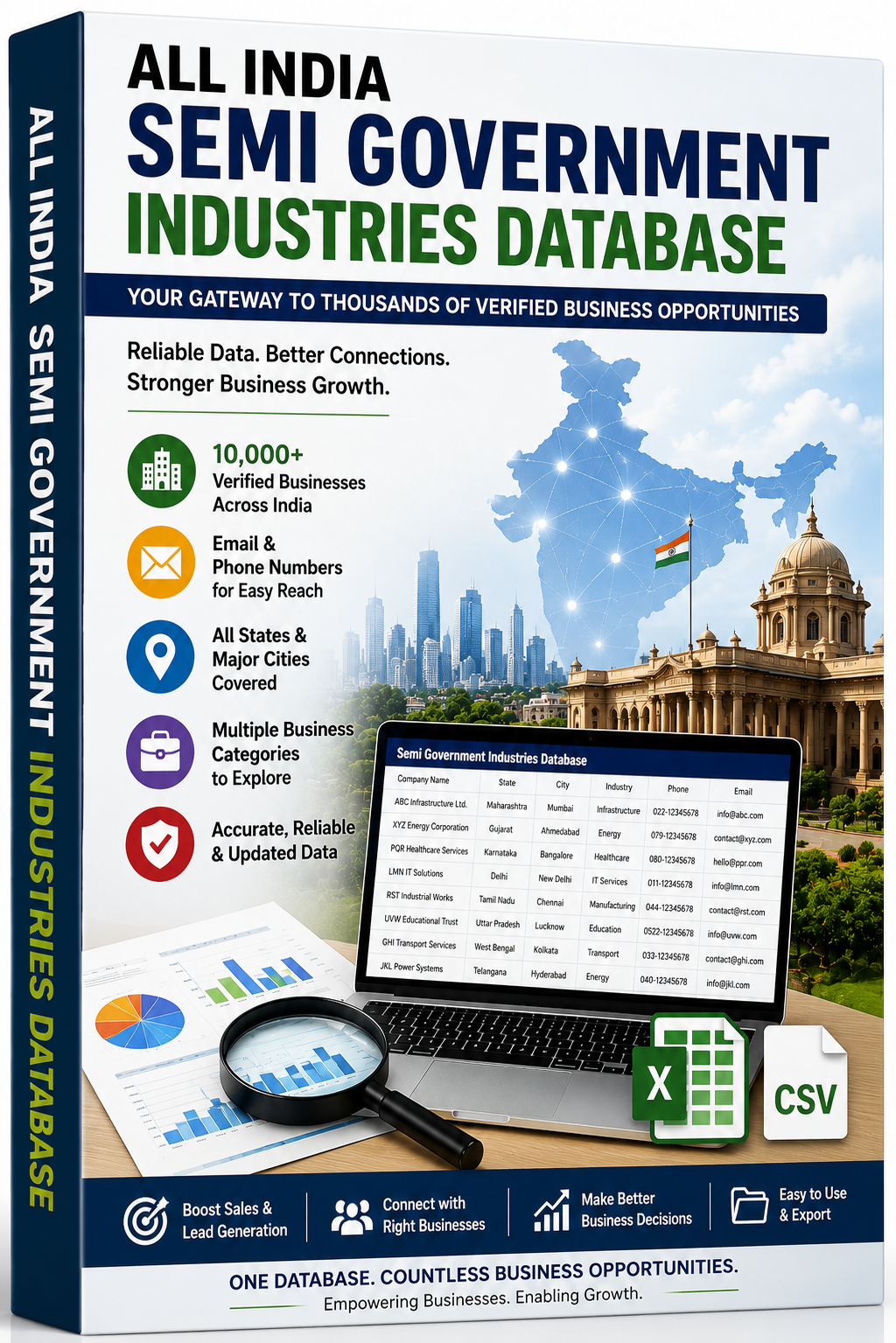
All India Semi Government Industries Database
₹ 1,000.00
All India Semi Government Industries Database
In a rapidly growing business environment, reliable industry information plays an important role in market research, business development, sales planning, and expansion. Companies operating in India often need to identify organizations across different states, cities, and industry sectors before developing a successful B2B strategy. An All India Semi Government Industries Database can provide a structured way to research semi-government organizations, government-associated industries, public institutions, and related business opportunities across the country.
India has one of the world’s most diverse business ecosystems, with organizations operating in manufacturing, infrastructure, energy, transportation, healthcare, education, engineering, technology, agriculture, finance, and many other sectors. Information about these organizations may be available through different sources, making research time-consuming for businesses that want to develop a nationwide market.
A properly organized industry database can help simplify this research process by bringing relevant business information into a structured format. It can support companies that are looking for potential business opportunities, market intelligence, supplier relationships, institutional partnerships, and industry-specific prospects.
What Is a Semi Government Industries Database?
A semi-government industries database is a structured collection of information related to organizations that have government ownership, government participation, public-sector connections, statutory responsibilities, institutional relationships, or other forms of association with government-supported activities.
The exact organizations included in a database can vary depending on its source, methodology, and update process. Records may contain information such as organization name, industry category, location, website, business address, publicly available contact information, and other relevant business details.
The purpose of such a database is primarily to make business research more organized. Instead of manually searching through numerous websites and directories, users can work with categorized information to identify organizations that may be relevant to their business objectives.
Why Industry Data Matters for Businesses
Business decisions are stronger when they are supported by relevant information. Before entering a new market, launching a service, or expanding into another region, companies need to understand their potential audience.
Industry databases can assist with several areas of business planning, including:
- Market research
- B2B prospect research
- Industry analysis
- Regional expansion planning
- Supplier discovery
- Partnership research
- Sales territory planning
- Business development
- Competitive research
- Customer segmentation
For example, a company providing enterprise software may want to research organizations that could require digital systems, automation, websites, mobile applications, data management solutions, or other technology services.
Similarly, an industrial supplier may use industry information to identify organizations operating in relevant manufacturing or infrastructure sectors.
Nationwide Coverage Across India
India consists of a large number of states, union territories, cities, industrial areas, and business clusters. Every region has its own economic strengths and important industries.
An India-wide database can help businesses research organizations across regions such as Maharashtra, Gujarat, Karnataka, Tamil Nadu, Telangana, West Bengal, Delhi, Haryana, Uttar Pradesh, Rajasthan, Kerala, Punjab, Odisha, Bihar, Jharkhand, Andhra Pradesh, Madhya Pradesh, Chhattisgarh, Assam, Uttarakhand, Goa, and other parts of the country.
Regional information can be particularly useful for companies planning to expand from a local market to a national market.
A business that currently operates in one state may use industry data to identify opportunities in another state without beginning its research from scratch.
Major Industry Categories
Semi-government and government-associated organizations can be connected with many different industries. A comprehensive database may categorize organizations according to their primary business activities.
Manufacturing and Engineering
India has a strong manufacturing and engineering ecosystem. Organizations may operate in machinery, industrial equipment, electrical products, automotive components, engineering services, chemicals, textiles, consumer products, and other manufacturing segments.
Businesses supplying machinery, software, professional services, maintenance solutions, equipment, or industrial products can research this sector to identify potential opportunities.
Infrastructure and Construction
Infrastructure is an important part of India’s economic development. Organizations involved in construction, transportation infrastructure, urban development, water management, roads, bridges, public facilities, and engineering projects can create opportunities for suppliers and service providers.
Industry information can help companies understand where relevant organizations are located and which sectors they operate in.
Energy and Utilities
The energy ecosystem includes power generation, transmission, distribution, renewable energy, utilities, and supporting industries.
Companies providing engineering services, technology solutions, equipment, maintenance, consulting, software, and other B2B services may research energy-related organizations as part of their market-development strategy.
Transportation and Logistics
Transportation and logistics play an essential role in India’s economy. Railways, ports, airports, road transportation, warehousing, logistics, and related services form a large interconnected industry.
Organizations working in this sector may require technology solutions, infrastructure services, communication systems, professional consulting, equipment, and other business services.
Healthcare and Pharmaceuticals
Healthcare organizations, pharmaceutical companies, research institutions, and medical facilities represent another major business segment.
Technology companies, equipment suppliers, facility-management providers, software developers, training companies, and professional service providers may research this sector for potential business opportunities.
Information Technology
Digital transformation has increased the demand for software, websites, mobile applications, cloud services, cybersecurity, automation, data management, and other technology solutions.
Businesses providing IT services can use industry information to identify organizations that may have relevant technology requirements.
Education and Training
Educational institutions, research organizations, skill-development bodies, and training providers are increasingly adopting digital platforms.
Potential requirements may include websites, learning management systems, mobile applications, student management software, communication tools, digital marketing, and other technology services.
Agriculture and Food Processing
Agriculture remains an important part of India’s economy. The sector includes agricultural organizations, food-processing units, storage facilities, packaging companies, distribution businesses, and supporting industries.
Businesses working in technology, logistics, packaging, equipment, consulting, and professional services may find industry data useful when researching this segment.
B2B Sales and Business Development
A well-organized database can support B2B sales teams by helping them identify organizations that match their target customer profile.
Rather than approaching every organization with the same message, businesses can divide prospects into relevant groups based on industry, location, organization type, or potential requirement.
This approach can make business communication more relevant and efficient.
For example, a digital solutions company may create separate prospect segments for manufacturing, healthcare, education, infrastructure, and logistics organizations. Each segment can then receive information that is appropriate to its business environment.
This type of targeted approach is generally more useful than broad, irrelevant communication.
Market Research Applications
An industry database can also be used for market research. Businesses entering a new geographical area can first identify the number and types of organizations operating within their target sector.
Research teams can study:
- Industry distribution
- Regional business activity
- Organization categories
- Potential customer segments
- Business clusters
- Market opportunities
- Potential suppliers
- Partnership possibilities
Database information should be combined with additional research and independent verification before important business decisions are made.
Lead Generation and Prospect Management
Lead generation is an important part of business growth. However, collecting a large number of records does not automatically create high-quality leads.
Businesses should first define their ideal customer profile. They can then use industry information to identify organizations that are relevant to their products or services.
After identifying potential prospects, businesses can organize them into categories and prioritize the most relevant opportunities.
A good prospect-management process can include:
- Identifying the target industry.
- Selecting relevant geographical areas.
- Researching suitable organizations.
- Verifying important business information.
- Categorizing prospects.
- Creating relevant business communication.
- Tracking responses and opportunities.
- Updating information regularly.
This systematic process can help businesses build a more organized sales pipeline.
Benefits for Small and Medium Businesses
Large companies often have dedicated research and sales teams, while small and medium-sized businesses may have limited resources. For these businesses, structured industry information can reduce the amount of time required for initial prospect research.
A database can help smaller organizations explore markets outside their immediate geographical area.
For example, a company operating primarily in Kolkata may want to expand into Maharashtra, Gujarat, Karnataka, or Tamil Nadu. Instead of beginning its research with thousands of unrelated searches, it can use categorized industry information as a starting point for identifying relevant organizations.
This can make expansion planning more systematic.
Supporting Digital Transformation
Digital transformation is changing the way organizations communicate, manage information, serve customers, and operate internal processes.
Organizations may require services such as:
- Website development
- Mobile application development
- Business software
- Enterprise solutions
- Digital marketing
- Search engine optimization
- Data management
- Cloud-based systems
- Automation
- Online communication platforms
For technology companies, industry databases can therefore serve as a research tool for identifying organizations that may benefit from digital solutions.
The database itself does not guarantee a business opportunity. Businesses should evaluate each prospect individually and determine whether there is a genuine need for their product or service.
Responsible Use of Business Information
Responsible use of business data is extremely important. Information should be used for legitimate research and professional business purposes and should be handled according to applicable laws, regulations, privacy requirements, and communication-platform policies.
Businesses should avoid misleading messages, excessive communication, unauthorized use of personal information, or unsolicited activity that violates applicable rules.
Important information should also be independently verified before it is used for commercial decisions.
Data can become outdated when organizations change addresses, websites, departments, management structures, or contact information. Regular verification and responsible data management are therefore essential.
How to Use an Industry Database Effectively
Getting the best value from an industry database requires a clear strategy.
First, identify the industries that are most relevant to your business. Next, select the geographical areas where you want to develop business opportunities.
After that, organize organizations according to relevant categories. Research each prospect before initiating communication and create a professional message that explains how your product or service can solve a genuine business problem.
Businesses should also maintain their own records of interactions and update information when changes are discovered.
This approach can transform a simple database into a useful business-development resource.
Choosing a Reliable Business Data Resource
When evaluating an industry database, businesses should consider factors such as data organization, coverage, update frequency, source methodology, categorization, usability, and transparency.
No database can guarantee that every record will remain accurate indefinitely. Organizations and business information change over time. Therefore, users should always verify important information before relying on it.
A useful database should make information easier to research while encouraging responsible and informed business decisions.
Conclusion
The All India Semi Government Industries Database can be a valuable resource for organizations involved in B2B sales, market research, business development, industry analysis, regional expansion, and professional networking.
India’s diverse economic landscape includes organizations across manufacturing, infrastructure, energy, transportation, healthcare, education, technology, agriculture, engineering, and many other sectors. A structured database can make it easier to research these sectors and identify organizations that may be relevant to specific business objectives.
For businesses planning national expansion, an India-wide industry database can provide a useful starting point for understanding potential markets and developing organized prospecting strategies.
However, successful business development depends on more than data alone. Companies should combine database research with independent verification, industry knowledge, thoughtful communication, ethical practices, and proper customer analysis.
The All India Semi Government Industries Database from Global IT Solutions Group is intended as a practical business information resource for organizations seeking to explore India’s diverse industrial ecosystem and identify potential opportunities in a structured manner.
Global IT Solutions Group focuses on digital solutions and business-oriented technology services, helping organizations explore modern opportunities in an increasingly connected business environment.
Important Disclaimer
Database information may change over time, and users should independently verify important organizational details before making business, financial, procurement, or marketing decisions. Information should be used responsibly and only for legitimate professional, research, and business purposes. Users are responsible for complying with applicable laws, privacy requirements, and communication policies when using business information.
Note: No website content can guarantee Google AdSense approval. For a stronger AdSense application, publish original, genuinely useful content alongside clear site navigation, About, Contact, Privacy Policy, Terms, and other appropriate trust pages, while avoiding misleading claims and low-value or duplicated content.
Related products
Reviews
There are no reviews yet.